

Sales commission tracking is one of the most operationally complex — and financially consequential — processes inside any revenue organization. Get it wrong and you’re looking at payout errors that erode rep trust, finance disputes that slow your close, and compliance risks that CFOs lose sleep over.
According to CaptivateIQ’s State of Incentive Compensation Report, companies still waste an average of 89 hours per month managing commissions manually. Research from Kennect shows that 83% of companies fail to pay commissions accurately when relying on manual systems, and an estimated 88% of spreadsheets contain errors. The business case for purpose-built commission tracking software isn’t subtle.
This guide covers what commission tracking software actually does, which features matter most, and how the top platforms compare in 2026 — including pricing realities and honest tradeoffs.
What commission tracking software actually does
At its core, commission tracking software automates the calculation, visibility, and reporting of sales commissions. In practice, it replaces a tangle of spreadsheets, manual reconciliations, and back-and-forth emails between Finance, RevOps, and sales reps.
The best platforms handle:
- Automated commission calculations based on comp plan rules (tiers, accelerators, splits, clawbacks, true-ups)
- CRM data sync so deals flow directly into compensation calculations without manual exports
- Rep-facing dashboards where salespeople can see real-time earnings and understand exactly how each payout was calculated
- Finance reporting with audit-ready detail for accruals, ASC 606 compliance, and payroll processing
- Plan administration so ops teams can update quota structures, add SPIFFs, or change rates without IT involvement
The distinction that matters for buyers in 2026: some platforms focus on rep motivation and gamification, others on finance-grade accuracy and auditability, and a few do both. Knowing which problem you’re actually trying to solve narrows the field quickly. A practical starting point is reviewing the 2026 ICM buyer’s guide before diving into vendor demos.
7 features that separate good platforms from great ones
Deal-level explainability. The best commission software shows exactly which deal, which rate, and which threshold produced each payout figure. Platforms that deliver this level of transparency cut disputes sharply — important given that 58% of enterprises report commission disputes at least twice per quarter. Without explainability, reps default to shadow accounting, maintaining their own spreadsheets because they don’t trust the official statements.
Real-time earnings dashboards. If reps can only see their commissions at month-end, motivation suffers. Research shows that reps with real-time earnings visibility hit their quotas at 14% higher rates. For more on what reps actually need to see day to day, our breakdown of sales commission dashboards for reps walks through the elements that matter most.
CRM integration depth. Native, bidirectional integrations with Salesforce and HubSpot matter more than surface-level connectors. The best platforms pull deal data automatically, keep compensation in sync as deal stages change, and flag data quality issues before they create payout errors.
Plan complexity support. Multi-tiered quotas, team splits, overlays, ramp schedules, draw reconciliations — complex organizations need software that handles all of it without custom engineering for every plan change. The gap between platforms on this dimension is substantial.
Finance-grade reporting and audit readiness. For CFOs, commission software functions as a financial controls system. Commission expense visibility, accrual support, audit trails, and ASC 606 compliance reporting are non-negotiable for mid-market and enterprise buyers. Many platforms advertise these features but deliver them inconsistently.
Implementation speed. Legacy platforms historically required 4–6 month implementations with expensive professional services. Modern alternatives have compressed this significantly. A comparison of commission management systems ranked by implementation speed shows average timelines ranging from under 4 weeks to nearly 6 months.
No-code plan administration. RevOps and finance teams shouldn’t need IT tickets every time a quota changes or a new SPIFF launches. This connects directly to automating sales commissions effectively — the challenge isn’t just automation, it’s staying agile as plans evolve.
The top 7 commission tracking platforms in 2026
1. EasyComp — best for fast implementation and transparent payouts
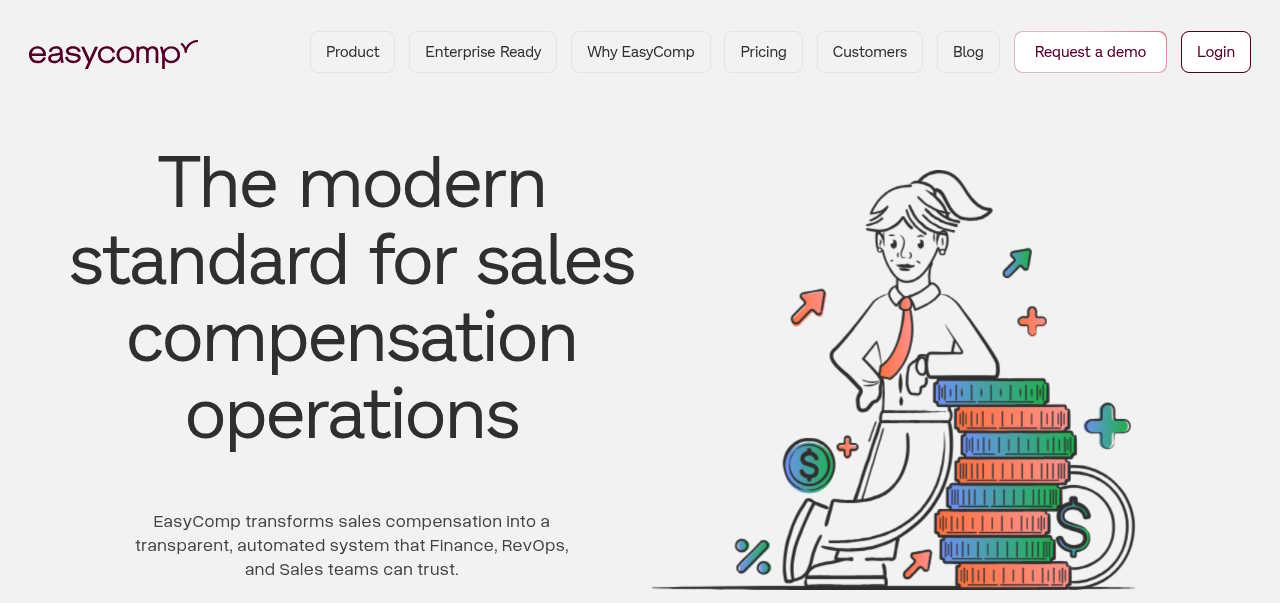
EasyComp is built for revenue and finance teams that need accurate, explainable commission management without a months-long implementation. The platform’s standout strength is deal-level commission explainability: reps can drill into any payout and see exactly which deals, rates, and thresholds produced the number — eliminating the trust deficit that causes shadow accounting and disputes.
Key capabilities include native integrations with Salesforce and HubSpot, support for complex plan structures (splits, accelerators, true-ups, clawbacks, ramp schedules), an AI copilot that answers natural-language questions about compensation, and anomaly detection that flags calculation errors before they reach payroll. Implementation typically runs 1–3 weeks. Clients like Alkira and Carrum Health have cited EasyComp specifically for saving hours previously lost to commission errors and increasing team morale through transparent payouts.
For CFOs evaluating the business case, EasyComp’s comp operations cost analysis provides a quantified estimate of potential savings based on your current operations.
Best for: Mid-market and enterprise teams prioritizing fast go-live, audit-ready accuracy, and rep-facing transparency Pricing: Starting around $30/user/month; implementation support included
2. CaptivateIQ — best for complex enterprise modeling
CaptivateIQ has built a strong reputation for handling the most complex compensation structures in the market. Its SmartGrid technology gives RevOps and Finance teams genuine flexibility without requiring custom code. The platform carries a 4.7/5 rating on G2 based on 1,780+ reviews — the highest review volume of any platform in the category.
Where it earns its reputation: multi-tier rate cards, complex territory overlays, and enterprise-scale plan modeling. The tradeoffs are real: implementations typically span several months with one-time professional services fees ranging from $10,000–$30,000. The pre-discount list price runs approximately $55/user/month, with a reported median annual spend of around $35,400 according to Vendr’s purchase data. An EasyComp vs CaptivateIQ comparison breaks down where the two platforms diverge on payout workflows and explainability.
Best for: Enterprise teams with highly complex, frequently-changing compensation structures Pricing: ~$55/user/month list price; quote-based; significant implementation costs
3. Salesforce Spiff — best for native Salesforce shops
Acquired by Salesforce, Spiff is the natural choice for organizations running their entire go-to-market motion inside the Salesforce ecosystem. The platform offers real-time commission visibility, a visual plan designer, commission estimators for reps, and workflow automation with audit trails. Deal data flows directly into compensation calculations without a separate integration layer.
The tradeoff: if your team doesn’t live in Salesforce — or operates in a multi-CRM environment — Spiff’s core advantage disappears. Pricing starts at roughly $75/user/year for core features, but enterprise configurations carry substantially higher costs.
Best for: Companies fully committed to the Salesforce platform stack Pricing: From ~$75/user/year; enterprise pricing is quote-based
4. Everstage — best for rep experience and engagement
Everstage has earned strong mid-market ratings for its user experience, particularly on the rep-facing side. The platform includes integrated SPIFF management, gamification elements (leaderboards, rep contests), and earnings dashboards that update in real time. Its no-code plan builder is accessible for RevOps teams without deep technical backgrounds.
Everstage’s strength is the rep experience layer. Organizations with the most complex finance reporting needs or multi-entity structures may find it less robust on the back-office side. A direct Everstage vs EasyComp comparison is useful for teams evaluating both platforms.
Best for: Mid-market teams where rep motivation and visible earnings are the primary goals Pricing: Contact vendor; transparent pricing model
5. Xactly Incent — best for global enterprise governance
Xactly Incent is the category’s legacy heavyweight. It’s the right choice for organizations that need SOX-compliant audit trails, deep compliance capabilities, and access to Xactly’s proprietary compensation benchmarking database — built from years of industry pay data. For global enterprises managing thousands of reps across multiple countries, Xactly’s governance depth is hard to replicate.
The cost and complexity tradeoffs are significant. Implementations run 4–6 months with dedicated consultants required. Annual fees frequently reach $15,000–$150,000+ depending on scale. Teams assessing alternatives should review Xactly alternatives in 2026 for a structured comparison.
Best for: Large global enterprises where compliance depth, audit trails, and benchmarking data matter most Pricing: Enterprise quote-based; high TCO
6. QuotaPath — best for growing teams with simpler plans
QuotaPath targets early-stage and scaling teams that need fast time-to-value and transparent pricing. The platform makes it easy for reps to see how close they are to their next payout threshold and offers direct pipeline-to-commission tracking. Setup is self-serve and can be completed in days.
The honest limitation: QuotaPath handles low-to-moderate plan complexity well but isn’t the right tool for organizations with heavily nested accelerators, multi-entity splits, or audit-heavy compliance requirements. A QuotaPath vs EasyComp breakdown covers where each platform fits.
Best for: Startups and SMBs with straightforward commission structures Pricing: Plans start around $35/user/month
7. Visdum — best for SaaS mid-market teams
Visdum positions itself specifically for mid-market SaaS businesses, offering AI-powered plan building and strong real-time commission visibility. It integrates with Salesforce and offers a no-code plan builder with analytics focused on quota attainment and plan effectiveness.
Best for: SaaS companies in the mid-market looking for a modern spreadsheet replacement Pricing: Custom mid-market pricing; contact vendor
Quick comparison: how the top platforms stack up
| Platform | Best for | Plan complexity | Implementation | Approx. pricing |
|---|---|---|---|---|
| EasyComp | Fast deployment + transparent payouts | High | 1–3 weeks | From ~$30/user/mo |
| CaptivateIQ | Complex enterprise modeling | Very high | Several months | ~$55/user/mo list |
| Salesforce Spiff | Salesforce-native teams | High | Weeks to months | From ~$75/user/yr |
| Everstage | Rep experience + gamification | High | Weeks | Contact vendor |
| Xactly Incent | Global enterprise governance | Very high | 4–6 months | High TCO |
| QuotaPath | Startups and SMBs | Low–moderate | Days | From ~$35/user/mo |
| Visdum | SaaS mid-market | Moderate–high | Weeks | Custom pricing |
How to make the final call: a buyer’s checklist
For finance leaders, the buying decision isn’t purely about feature counts. These questions drive the real decision:
What is the true cost of your current process? Factor in finance team hours, payout errors (industry data puts manual error rates at approximately 8.8% of total payouts), and the downstream cost of commission disputes. A CFO.com report found that 43% of finance and sales leaders say their sales forecasts are off by at least 10% — better commission data tightens that gap.
Can the platform handle your specific plan structures? Test your hardest edge cases in the demo — multi-territory splits, accelerator stacking, true-ups, and clawbacks. Don’t evaluate on sanitized examples. Reviewing sales compensation plan best practices before entering demos helps you ask sharper questions.
What does the rep experience look like? Platforms where reps can’t self-serve the ‘why’ behind their payouts generate ongoing dispute tickets. That administrative drag lands back on Finance. Our guide on how to provide commission statements to reps the right way in 2026 outlines what good rep-facing delivery actually looks like.
What is the realistic implementation timeline — and what happens after? Many platforms quote fast go-lives but require months of configuration. Ask for reference customer timelines on organizations with similar plan complexity, and understand what plan changes cost after implementation. Nearly half of CFOs cite automation of manual processes as a top 2026 priority, according to a January 2026 Deloitte CFO Signals survey — platform agility post-launch matters as much as initial setup.
What does the audit trail look like? Finance and audit teams must be able to trace every payout back to defined rules. If the platform can’t produce deal-level audit documentation on demand, it’s not ready for enterprise use. Reviewing how to eliminate errors in sales compensation reporting outlines what a defensible audit trail actually requires.
The right choice depends on what’s actually broken
Organizations replacing spreadsheets for the first time often default to whichever platform has the most brand recognition. That’s not always the right call.
For mid-market and enterprise teams where implementation speed, payout accuracy, and rep transparency are the priorities, EasyComp is worth a serious look — particularly for organizations that can’t afford a multi-month implementation or ongoing dependency on external consultants for plan changes.
For enterprise organizations with globally distributed teams and deep compliance requirements, CaptivateIQ or Xactly Incent offer the sophistication to match. For Salesforce-native shops, Spiff integrates seamlessly. For early-stage teams that need something live in days, QuotaPath gets the job done at a price point that doesn’t require budget approval.
The most useful next step: run a side-by-side comparison of leading sales compensation platforms with your specific plan structures in hand. A platform that handles your edge cases cleanly in a demo will handle them in production.