

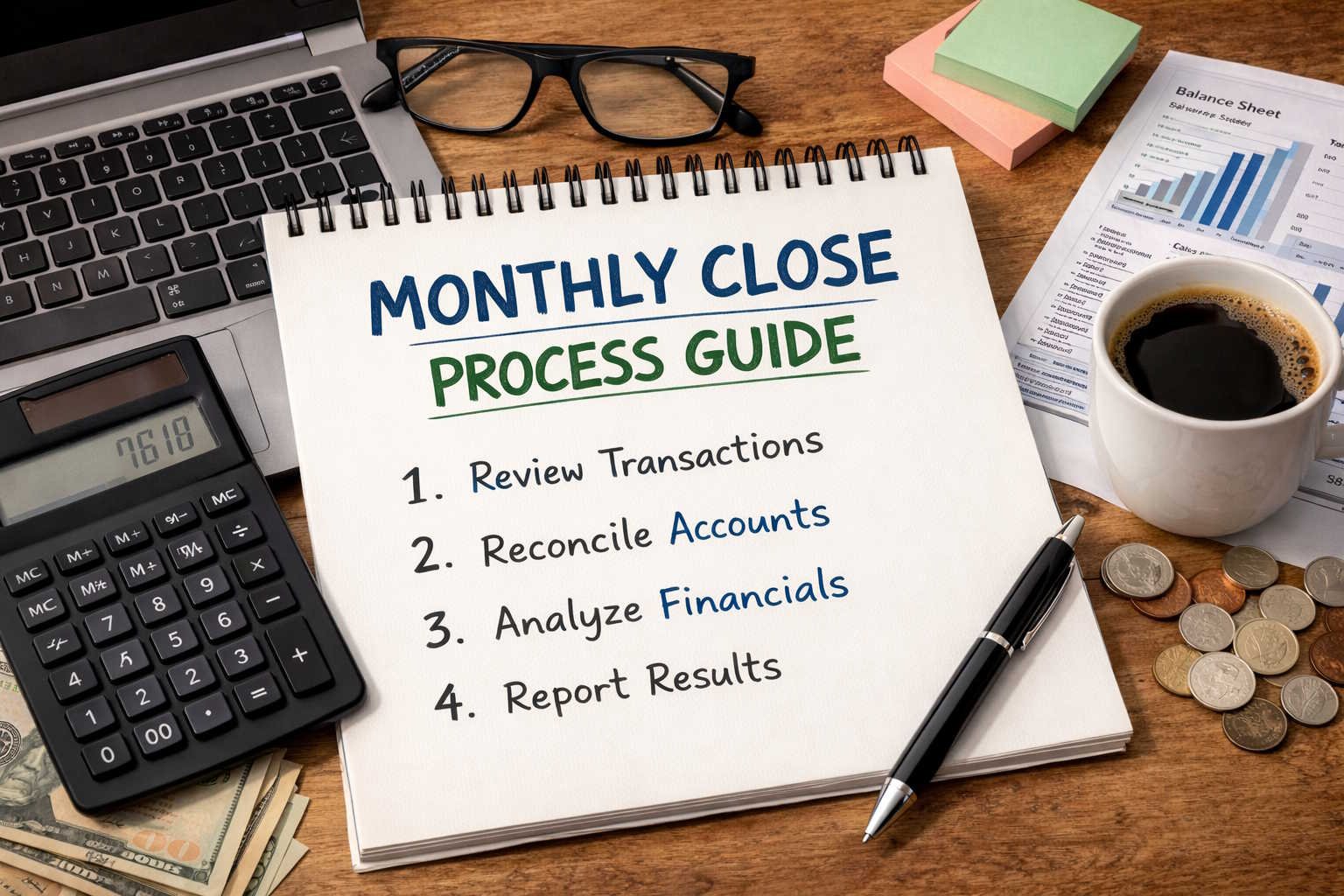
The monthly close is the heartbeat of the finance function. Every financial statement, every board report, and every forecast depends on a clean, timely close. Yet many finance teams struggle with slow closes, manual processes, and last-minute scrambles.
This guide provides a structured approach to running an efficient monthly close.
Why the Monthly Close Matters
A fast, accurate close enables:
- Timely management reporting: Leadership makes better decisions with fresher data
- Reliable forecasting: FP&A teams need clean actuals to update their models
- Audit readiness: A well-documented close reduces audit friction and cost
- Investor and board confidence: Consistent, professional reporting builds trust
The Close Calendar
Every close should follow a detailed calendar that assigns specific tasks to specific people on specific days. Here is a sample 7-business-day close calendar:
Day 1: Data Collection and Cutoff
- Close AP for the prior month (no new invoices for the closed period)
- Import bank feeds and credit card transactions
- Run payroll accrual based on pay period timing
- Receive revenue data from the billing system
- Close expense report submissions
Day 2: Revenue and AR
- Post revenue recognition entries (ASC 606 calculations)
- Reconcile deferred revenue and the contract waterfall
- Post accounts receivable entries and update aging
- Review unbilled revenue and accrued revenue entries
Day 3: Expenses, Payroll, and Accruals
- Post payroll journal entries
- Record accrued expenses (rent, insurance, professional services)
- Post prepaid expense amortization entries
- Record depreciation and amortization
Day 4: Intercompany, Equity, and Debt
- Complete intercompany eliminations (for multi-entity companies)
- Post stock-based compensation expense
- Record interest expense and debt-related entries
- Post any one-time or unusual entries with appropriate documentation
Day 5: Reconciliations
- Complete bank reconciliations
- Reconcile all balance sheet accounts (AR, AP, prepaids, accrued liabilities, fixed assets, deferred revenue)
- Review the trial balance for unusual balances or unexpected changes
- Clear any suspense or clearing accounts
Day 6: Flux Analysis and Review
- Run P&L variance analysis: actual vs. budget, actual vs. prior month, actual vs. prior year
- Investigate and document all material variances (typically >10% and >$5K)
- Review balance sheet trends for reasonableness
- Finance manager or controller reviews all entries and reconciliations
Day 7: Reporting and Distribution
- Prepare the management reporting package
- Finalize the board-ready financial statements
- Distribute the package to leadership
- Archive close workpapers and documentation
- Conduct a brief close retrospective (what went well, what to improve)
Key Close Procedures in Detail
Account Reconciliations
Every balance sheet account should be reconciled monthly. A proper reconciliation includes:
- GL balance: The ending balance per the general ledger
- Supporting detail: An itemized list of what makes up that balance
- Reconciling items: Differences between the GL and supporting detail, with explanations and expected resolution dates
- Preparer and reviewer sign-off: Segregation of duties matters
| Account | GL Balance | Support Balance | Difference | Status |
|---|---|---|---|---|
| Cash - Operating | $2,450,000 | $2,450,000 | $0 | Reconciled |
| Accounts Receivable | $1,890,000 | $1,890,000 | $0 | Reconciled |
| Prepaid Expenses | $340,000 | $340,000 | $0 | Reconciled |
| Deferred Revenue | $4,200,000 | $4,200,000 | $0 | Reconciled |
Flux Analysis
For each P&L line, calculate:
- Actual vs. Budget: Measures planning accuracy
- Actual vs. Prior Month: Highlights month-over-month changes
- Actual vs. Prior Year: Shows year-over-year trends
Flag any variance that exceeds a materiality threshold (commonly 10% and $5K). For each flagged variance, document:
- What caused the variance
- Whether it is one-time or recurring
- Whether the forecast needs to be updated
Management Reporting Package
A standard monthly reporting package includes:
- Executive summary: 1-page narrative of the month’s financial performance
- Income statement: Actual vs. budget vs. prior year with variance commentary
- Balance sheet: Key balance sheet metrics and changes
- Cash flow: Operating, investing, and financing activities
- Key metrics dashboard: Revenue metrics, headcount, burn rate, runway
- Department-level P&L: Actual vs. budget by cost center
- Forecast update: Any changes to the full-year outlook based on month’s results
Best Practices for Reducing Close Time
Automate Data Feeds
Connect your bank, payroll provider, billing system, and expense tool directly to your GL. Manual data entry is the single biggest source of close delays and errors.
Pre-Close Activities
Move work forward into the last week of the month:
- Accrue known expenses before month-end
- Reconcile accounts through the 25th
- Prepare standard journal entry templates
- Confirm all employee expenses are submitted by the 28th
Standardize Templates
Use consistent reconciliation and journal entry templates across all accounts. Standardization reduces training time, speeds up review, and makes it easier to identify errors.
Implement a Close Checklist
Use a shared checklist (in your close management tool, or even a simple spreadsheet) where each task has:
- Task name
- Owner
- Due date (business day)
- Status (not started / in progress / complete)
- Reviewer
Continuous Improvement
After each close, spend 15 minutes on a retrospective:
- What took longer than expected?
- What errors were found?
- What can be automated or moved to pre-close?
Track close time in business days each month and set a target to improve by one day per quarter.
Key Takeaways
The monthly close is a repeatable process that improves with structure and discipline. Build a detailed close calendar, assign clear ownership, automate data feeds, and enforce deadlines. Invest in pre-close activities to pull work forward, run thorough flux analysis to catch errors, and deliver a professional reporting package that gives leadership confidence in the numbers.