

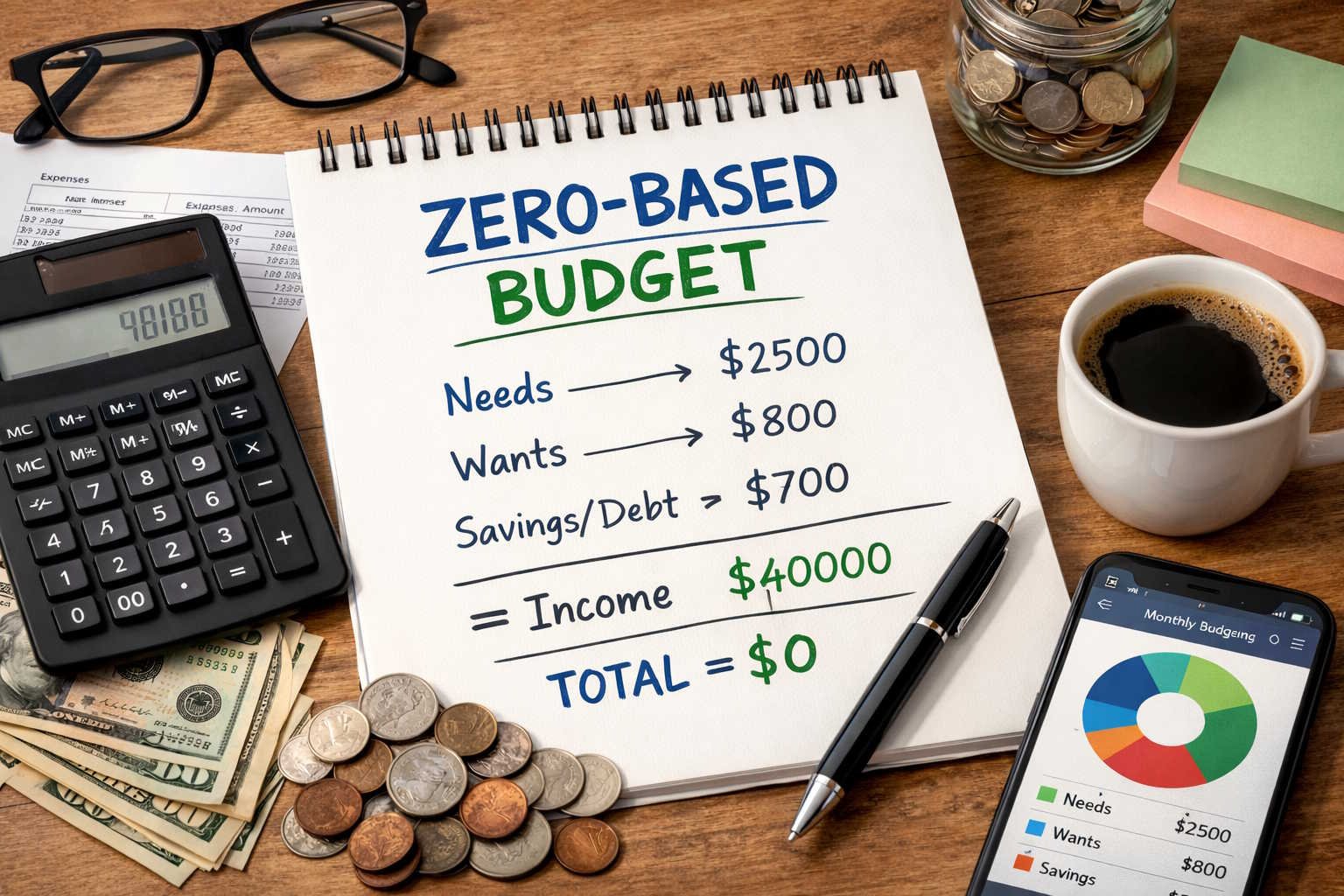
Zero-based budgeting forces every department to justify every dollar of spending from scratch. It is one of the most powerful tools in corporate finance for eliminating waste and reallocating resources to high-value activities.
This guide explains how ZBB works, when it makes sense, and how to run a zero-based budget cycle without overwhelming your organization.
What Is Zero-Based Budgeting?
In traditional budgeting, the prior year’s budget is the starting point. Departments request incremental increases (or occasionally decreases) and the finance team negotiates from there.
Zero-based budgeting flips this approach. Every budget starts at zero. Each department must build its spending plan from the ground up by defining decision packages—discrete bundles of activities with associated costs, outputs, and business justification.
The finance team then ranks all decision packages across the organization by cost-benefit and funds them in priority order until the budget is exhausted.
The ZBB Process: Step by Step
Step 1: Define Cost Centers and Decision Units
Break the organization into decision units—typically at the department or functional level. Each decision unit is responsible for building its own set of decision packages.
Examples of decision units: - Marketing → Demand Generation - Marketing → Brand & Content - Engineering → Platform Team - Sales → Commercial Sales Team - G&A → Finance & Accounting
Step 2: Build Decision Packages
Each decision unit creates decision packages that describe specific activities or programs. A decision package should include:
- Description: What the activity or program does
- Cost: Total cost including headcount, tools, vendors, and discretionary spend
- Output: What business outcome the activity produces (leads generated, features shipped, contracts processed)
- Ranking: Internal priority within the decision unit (mandatory, high, medium, low)
Example decision packages for Demand Generation:
| Package | Annual Cost | Output | Priority |
|---|---|---|---|
| Core SEM program | $180,000 | 4,200 MQLs | Mandatory |
| Content marketing team (2 FTEs) | $220,000 | 150 articles, SEO traffic | High |
| ABM platform & campaigns | $150,000 | 80 enterprise MQLs | Medium |
| Event sponsorships | $120,000 | 500 leads, brand awareness | Low |
Step 3: Rank Decision Packages Across the Organization
This is where ZBB delivers its value. The finance team consolidates all decision packages and ranks them organization-wide. Ranking criteria typically include:
- Revenue impact: Does this activity directly drive revenue or pipeline?
- Cost avoidance: Does cutting this activity create downstream costs or risks?
- Strategic alignment: Does this activity support a top-3 company priority?
- Efficiency: What is the cost per unit of output?
Step 4: Set the Funding Line
Once packages are ranked, draw a funding line at the total budget target. Everything above the line gets funded. Everything below gets deferred, reduced, or eliminated.
This creates hard trade-off conversations: “Should we fund the ABM platform or add a second recruiter?” Those conversations are the point of ZBB—they force resource allocation decisions that incremental budgeting obscures.
Step 5: Approve and Monitor
After leadership approves the funded packages, each decision unit operates within its approved budget. During the year, monitor actual spending against each decision package (not just the department total) to ensure resources are being used as intended.
When Zero-Based Budgeting Makes Sense
ZBB is not the right approach for every company or every budget cycle. It works best when:
- Costs have grown faster than revenue: Common after periods of hypergrowth when hiring and tool proliferation outpace planning.
- Post-M&A integration: Merging two companies creates overlapping functions that ZBB can identify and consolidate.
- Strategic pivot: When the company is shifting focus (e.g., moving upmarket, entering a new geography), ZBB ensures the budget reflects the new strategy rather than historical inertia.
- Leadership mandate for efficiency: A new CFO or CEO who wants to “reset” the cost structure.
Common ZBB Pitfalls and How to Avoid Them
Pitfall 1: Applying ZBB to Everything
Running ZBB on fixed costs like rent, insurance, and debt service is a waste of time. Focus ZBB on discretionary and semi-discretionary categories: marketing spend, T&E, professional services, software tools, and contractor spend.
Pitfall 2: Short-Term Bias
Teams will cut R&D, training, and long-term brand investments because the ROI is harder to quantify. Protect strategic investments by creating a separate “strategic investment” category that is evaluated on a longer time horizon.
Pitfall 3: Budget Gaming
Managers learn to inflate decision packages so they look “generous” when cut to the real number. Combat this by requiring unit-cost benchmarks (e.g., “cost per hire should be $8K-12K based on market data”) and having FP&A validate assumptions.
Pitfall 4: Annual-Only Application
Some companies run ZBB annually, which is exhausting. Consider a rotating ZBB approach: apply ZBB to 2-3 cost centers per quarter so each area gets a deep review every 2-3 years.
Practical Tips for Implementation
- Start with a pilot: Apply ZBB to one department first (marketing is a popular choice) before rolling it out company-wide.
- Use templates: Provide standardized decision package templates so every department submits comparable data.
- Invest in training: Department leaders who have never done ZBB will need coaching on how to define packages and rank priorities.
- Communicate the “why”: ZBB can feel threatening to budget holders. Be transparent about objectives—cost optimization, reallocation, or both.
- Track results: After the budget year, measure whether ZBB actually changed spending patterns and improved efficiency metrics.
Key Takeaways
Zero-based budgeting is a disciplined approach to resource allocation that eliminates the “because we spent it last year” justification. It is more work than incremental budgeting, but when applied to the right categories at the right time, it surfaces waste, forces trade-offs, and aligns spending with strategy.
Start with discretionary categories, use decision packages to make trade-offs visible, and protect long-term strategic investments from short-term cuts.