
ASC 606 changed the way companies recognize revenue across every industry. For finance teams at SaaS and technology companies, getting it right is critical for accurate financial statements, investor confidence, and audit readiness.
This guide walks through the five-step model with practical examples and common pitfalls.
The Five-Step Revenue Recognition Model
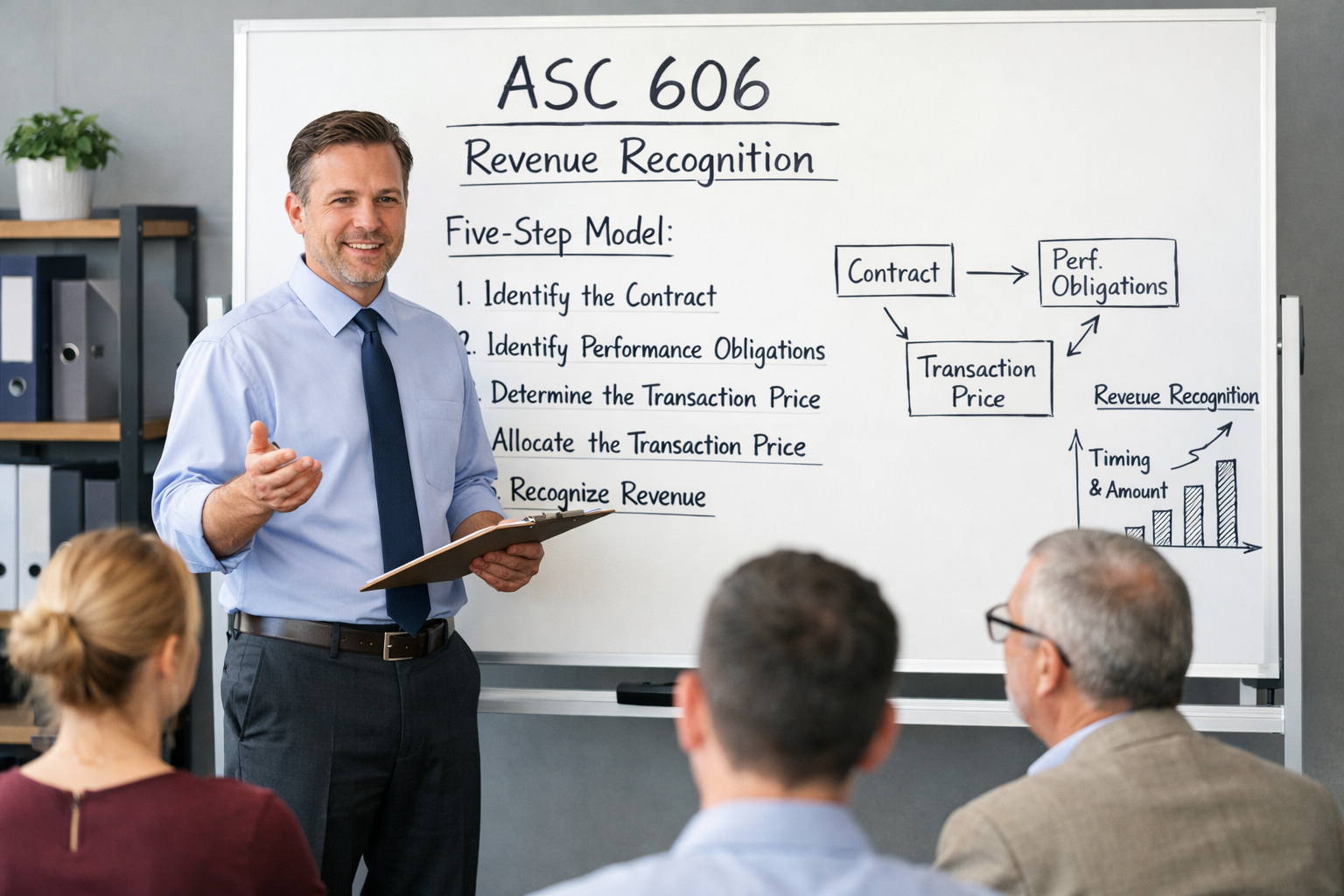
ASC 606 establishes a single, principles-based framework built on five sequential steps.
Step 1: Identify the Contract
A contract exists when all of the following criteria are met:
- Both parties have approved the contract and are committed to their obligations
- Each party’s rights regarding goods or services are identifiable
- Payment terms are identifiable
- The contract has commercial substance
- Collection of consideration is probable
Practical tip: In SaaS, watch for contracts with non-standard terms—such as extended payment terms, cancellation clauses, or pilot periods—that may affect whether a valid contract exists at inception.
Step 2: Identify Performance Obligations
A performance obligation is a distinct promise to deliver a good or service. Two criteria determine distinctness:
- Capable of being distinct: The customer can benefit from the good or service on its own or together with other readily available resources.
- Distinct within the context of the contract: The promise is separately identifiable from other promises.
Common SaaS Performance Obligations
| Deliverable | Typically Distinct? | Notes |
|---|---|---|
| SaaS subscription access | Yes | Core deliverable; recognized ratably |
| Implementation / onboarding | It depends | Distinct if customer could use a third party; not distinct if highly customized |
| Professional services (training) | Yes | Usually distinct and recognized as delivered |
| Premium support | Yes | Recognized ratably over support period |
| Data migration | It depends | Depends on complexity and interdependence |
Step 3: Determine the Transaction Price
The transaction price is the amount of consideration the company expects to receive. Key components include:
- Fixed consideration: The stated contract price
- Variable consideration: Usage fees, performance bonuses, volume discounts, penalties
- Significant financing component: Relevant for contracts with payment terms exceeding 12 months
- Non-cash consideration: Equity or barter arrangements
For variable consideration, estimate using either the expected value method (probability-weighted) or the most likely amount method, then apply the constraint: include variable consideration only to the extent it is “probable that a significant reversal will not occur.”
Step 4: Allocate the Transaction Price
When a contract contains multiple performance obligations, allocate the total transaction price to each obligation based on its relative standalone selling price (SSP).
Methods for determining SSP (in order of preference):
- Adjusted market assessment: What would the market pay for the good or service?
- Expected cost plus margin: What does it cost to deliver, plus a reasonable margin?
- Residual approach: Used only when the SSP is highly variable or uncertain
Example: A $120,000 annual SaaS contract includes subscription ($100K SSP), implementation ($25K SSP), and training ($15K SSP). Total SSP = $140K. Allocation:
- Subscription: $120K × ($100K / $140K) = $85,714
- Implementation: $120K × ($25K / $140K) = $21,429
- Training: $120K × ($15K / $140K) = $12,857
Step 5: Recognize Revenue
Revenue is recognized when (or as) a performance obligation is satisfied by transferring control of the promised good or service.
- Over time: If one of three criteria is met—customer simultaneously receives and consumes benefits, the company’s performance creates or enhances an asset controlled by the customer, or the company’s performance does not create an asset with alternative use and the company has an enforceable right to payment.
- At a point in time: If none of the over-time criteria are met.
For SaaS subscriptions, revenue is almost always recognized over time (ratably) because the customer simultaneously receives and consumes the benefits of the hosted service.
Common Challenges for SaaS Companies
Bundled Contracts and Free Periods
Many SaaS contracts include free months, discounted periods, or bundled add-ons. Under ASC 606, you cannot simply “skip” revenue recognition during the free period. The total transaction price must be allocated across all performance obligations and recognized over the complete contract term.
Contract Modifications
When contracts are amended mid-term—upgrades, downgrades, renewals, or scope changes—you must determine whether the modification is:
- A separate contract (if it adds distinct goods/services at standalone selling price)
- A modification of the existing contract (prospective or cumulative catch-up treatment)
Material Rights and Renewal Options
If a contract gives the customer an option to renew at a discount that constitutes a “material right,” that option is a separate performance obligation. Allocate a portion of the transaction price to the renewal option and recognize it when the option is exercised or expires.
Principal vs. Agent Considerations
When you resell third-party services, determine whether you are a principal (recognize gross revenue) or an agent (recognize net revenue). The key indicator is whether you control the good or service before it is transferred to the customer.
Building an ASC 606 Compliance Process
- Contract inventory: Maintain a complete database of active contracts with key terms.
- SSP analysis: Update standalone selling price analyses quarterly using actual transaction data.
- Judgment documentation: Document all significant judgments (e.g., “implementation services are not distinct because…”) in a policy memo.
- Waterfall schedules: Use revenue waterfall schedules that show beginning deferred revenue, new bookings, recognized revenue, and ending deferred revenue by contract.
- Disclosure preparation: Prepare disaggregated revenue disclosures (by geography, product, timing of transfer) as part of quarterly close.
Key Takeaways
ASC 606 is principles-based, which means it requires judgment at every step. The five-step model provides a consistent framework, but the real work is in applying it to your specific contract structures. Build repeatable processes, document your judgments, and keep your SSP analysis current—your auditors will thank you.